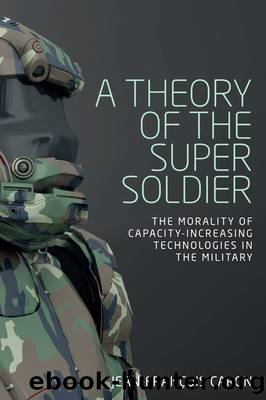
A Theory of the Super Soldier by Caron Jean-François
Author:Caron, Jean-François
Language: eng
Format: epub
ISBN: 9781526117779
Publisher: Manchester University Press
Published: 2018-03-21T16:00:00+00:00
This desire to make reconciliation prevail over retribution does not apply to soldiers whose capacities have been increased by technologies. In their case, retribution would not negatively affect the establishment of reconciliation between the former warring parties. On the contrary, their trial would be beneficial for this objective, as it would show the defeated party that even the victors punish wrongdoers for crimes committed during wartime. According to May, the obligation to put these individuals on trial is unquestionable.25 The subtlety about the question has more to do with whether they should be tried during or after conflict (May, 2012, pp. 75â80).
In view of this normative position, we may wonder how it is possible to have retribution in cases when soldiers have committed war crimes on the battlefield while under the influence of medicines or technologies that directly or indirectly altered their moral agency. In other words, if soldiers commit wrongdoings because of involuntary intoxication or as an unintentional result of the drugs and technologies they have agreed to use, this may create legal loopholes that may make it impossible to try them. Retribution as a condition of reconciliation may be harmed in this context, and would contribute to leaving open the scars of war between former enemies, since individuals who had taken part in crimes during the conflict would remain free from prosecution.
Moreover, the ability to charge a soldier for alleged war crimes often depends on the capacity to find witnesses who are willing and able to testify. Thanks to Hugh Thompson Jr, this is how the My Lai massacre was denounced. However, capacity-increasing technologies might render this possibility a mere illusion. Such is the danger with technologies and medicines that tend to alter soldiersâ memory. Once again, this desire relies on good intentions and is in accordance with the army's duty of care towards its members. It is useful to remember that this includes its obligation not only to deploy all necessary means in order to prevent its members from being harmed or killed on the battlefield, but also to make sure that they will be able to resume normal life after their departure from the army. Thus fighting against the prevalence of PTSD is a moral obligation on the part of the military. While only 8 per cent of the general population is affected by this condition, the proportion increases to 30 per cent for individuals who currently are or have been enlisted in the military (US Department of Veterans Affairs, n.d.) â a problem that cannot be ignored. Approximately 75 per cent of former soldiers suffering from PTSD also have substance abuse disorder, and PTSD is also associated with a significantly higher risk of suicide than in the general population â45 per cent higher according to the Ombudsman of Canadian Ministry of National Defence (National Defence and the Canadian Armed Forces, 2016) â as well as violent outbursts. Needless to say, as argued by the US President's Council on Bioethics (Beyond Therapy, 2003), PTSD makes daily life hard or even impossible.
Download
This site does not store any files on its server. We only index and link to content provided by other sites. Please contact the content providers to delete copyright contents if any and email us, we'll remove relevant links or contents immediately.
| Anthropology | Archaeology |
| Philosophy | Politics & Government |
| Social Sciences | Sociology |
| Women's Studies |
The Secret History by Donna Tartt(19320)
The Social Justice Warrior Handbook by Lisa De Pasquale(12228)
Thirteen Reasons Why by Jay Asher(9011)
This Is How You Lose Her by Junot Diaz(6965)
Weapons of Math Destruction by Cathy O'Neil(6373)
Zero to One by Peter Thiel(5876)
Beartown by Fredrik Backman(5859)
The Myth of the Strong Leader by Archie Brown(5554)
The Fire Next Time by James Baldwin(5509)
How Democracies Die by Steven Levitsky & Daniel Ziblatt(5280)
Promise Me, Dad by Joe Biden(5193)
Stone's Rules by Roger Stone(5138)
A Higher Loyalty: Truth, Lies, and Leadership by James Comey(5021)
100 Deadly Skills by Clint Emerson(4975)
Rise and Kill First by Ronen Bergman(4842)
Secrecy World by Jake Bernstein(4807)
The David Icke Guide to the Global Conspiracy (and how to end it) by David Icke(4777)
The Doomsday Machine by Daniel Ellsberg(4559)
The Farm by Tom Rob Smith(4557)
